Projects
Technologies: Python, FastAPI, PostgreSQL, Supabase, SQLAlchemy, Alembic, Jinja2, Anthropic Claude API, JavaScript, Chrome Extension, ReportLab, Docker, GitHub Actions, Oracle Cloud
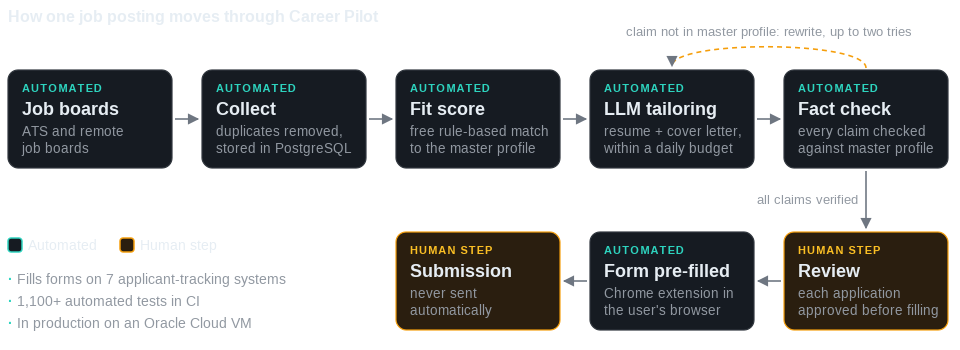
- Deployed Platform: FastAPI and Jinja2 application on an Oracle Cloud VM behind Caddy HTTPS, backed by Supabase PostgreSQL with row-level security on every table and Alembic migrations.
- Guarded AI Tailoring: Tailors resumes and cover letters with Claude (provider-agnostic, with Gemini and Ollama as alternates), checked by a non-LLM guardrail that blocks any skill or claim not in the master profile, plus a ReAct research agent with tool-calling over the app's own data.
- Application Autofill Extension: Chrome extension that fills applications on 7 applicant-tracking systems (Greenhouse, Lever, Ashby, Recruitee, Personio, Workable, SmartRecruiters), including Shadow DOM forms, file attachment and honeypot-field detection; nothing is ever submitted without a human click.
- Cost-Controlled Intake: Ingests postings from direct ATS boards and remote job boards, runs free mechanical scoring before any paid LLM call, and enforces a daily LLM spend cap; resumes render to PDF with ReportLab and page-count check.
- Tested and Operated in Production: 1,100+ pytest tests in a GitHub Actions CI pipeline; traced a database egress-quota breach to a dedup query fetching full job descriptions, and removed a ~90-second deploy outage caused by a blocking scheduler shutdown.
Technologies: PySpark, Spark SQL, Scala, Great Expectations, Apache Airflow, Apache Hive, Apache Hadoop (HDFS, MapReduce)
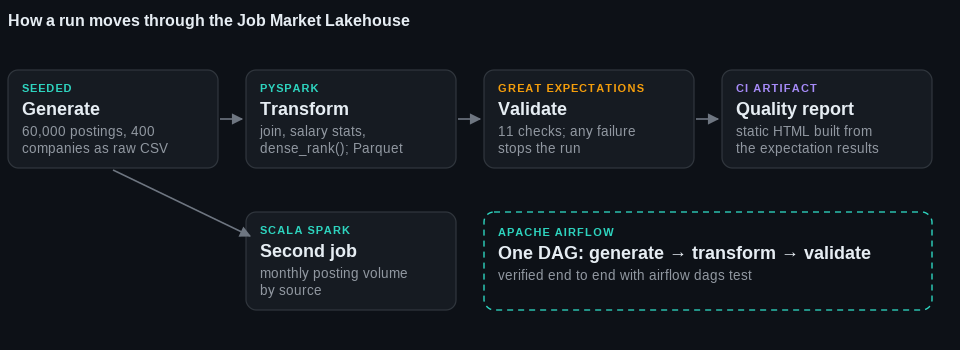
- PySpark Transformation Pipeline: Built PySpark job over 60k synthetic postings -- a join, a groupBy/agg salary-stats aggregation, and a dense_rank() window function ranking postings within each industry.
- Scala Spark Job: Wrote a complementary Scala Spark SQL job (monthly posting-volume-by-source aggregation), run via spark-shell against Spark distribution.
- Data Quality Gating: Wrote 11 Great Expectations checks (row counts, categorical sets, uniqueness, a cross-column comparison) validating the PySpark output.
- Pipeline Orchestration: Built Airflow DAG (generate -> transform -> validate) verified end-to-end via `airflow dags test` -- fixed pydantic/typing_extensions dependency conflict by isolating Airflow's own environment from the pipeline's.
- Hive Tables (HiveQL): Built an external text table over the raw CSV and a Parquet table partitioned by month, filled with a dynamic-partition INSERT OVERWRITE through Spark's Hive support; in CI 60,000 rows land in 20 partitions, MSCK REPAIR TABLE registers a partition written straight to storage, and a month filter prunes to one partition (3,015 rows).
- Hadoop HDFS & MapReduce: Started a single-node HDFS (NameNode and DataNode) in CI, loaded the raw postings into it, and ran a Hadoop Streaming MapReduce job (Python mapper and reducer, 2 reducers) counting postings per month and source; its 100 counts match PySpark reading the same file from HDFS exactly.
Technologies: Databricks, dbt, SQL, Dimensional Modeling
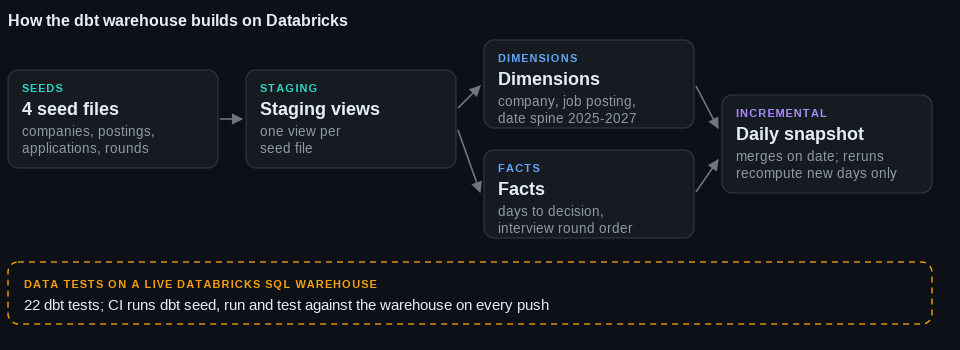
- Dimensional Data Model: Built a dbt project (staging views into dimension and fact tables) on a live Databricks SQL warehouse, including a datediff-based days-to-decision measure and a row_number() window function for interview-round sequencing.
- Data Quality Testing: Wrote 22 dbt tests (20 schema tests for uniqueness, not-null, referential integrity and accepted values, plus 2 business-rule tests: a decision date never precedes the applied date, and snapshot counts never go negative), run against the warehouse in CI.
- Verified End-to-End: Ran dbt seed/run/test against a live Databricks warehouse (not just parsed) and spot-checked the resulting tables by hand; CI re-runs the same three commands against the same warehouse on every push using repository secrets.
Technologies: FastAPI, Python, SQL, Scikit-Learn, Chart.js, SQLite, XGBoost, GitHub Actions, MLflow, GraphQL
- Low-Latency API Pipeline: Engineered an end-to-end credit risk evaluation pipeline using FastAPI and Python, achieving sub-100ms API response latency for real-time validation (67 ms median in the test suite).
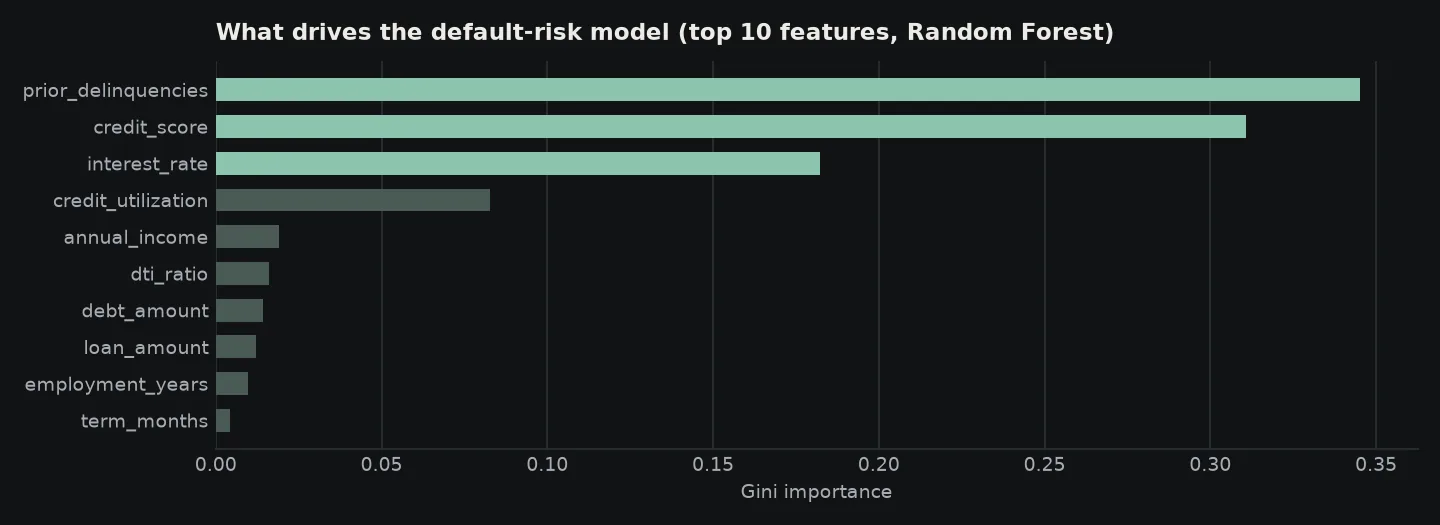
- Machine Learning Risk Classifier: Trained and benchmarked XGBoost against a Random Forest ensemble in Scikit-Learn to predict loan default probability, selecting Random Forest for production with 93.4% precision on declined applications (0.92 ROC-AUC on a held-out set), tracked in MLflow for experiment comparison.
- Interactive Chart.js Dashboard: Developed SQLite schemas and transactional fraud anomaly checks with Chart.js dashboard integration to streamline credit approval cycles.
- Real-Time Anomaly Flagging: Embedded velocity, amount-spike and foreign-location rules and scored them against labelled planted fraud; the velocity rule caught all 1,110 planted card-testing charges with no false alarms.
- GraphQL API Layer: Added a Strawberry-GraphQL query layer alongside the existing REST endpoints, serving customer and loan data from the same database.
Technologies: Python, SQL, Snowflake, Azure ADLS, Streamlit UI, Scikit-Learn, SQL Server, Terraform, Parquet, Delta Lake, Apache Iceberg, TypeScript, Jenkins
- ElevateMe Bootcamp Capstone: Built on the bootcamp's business data, connecting SQL Server, Azure ADLS Gen2, Snowflake, and Streamlit, accelerating financial queries by 45% and achieving 100% payment reconciliation accuracy.
- Interactive Multi-Page Web UI: Built a multi-page web application using Python and Streamlit, delivering intuitive event data visualization components.
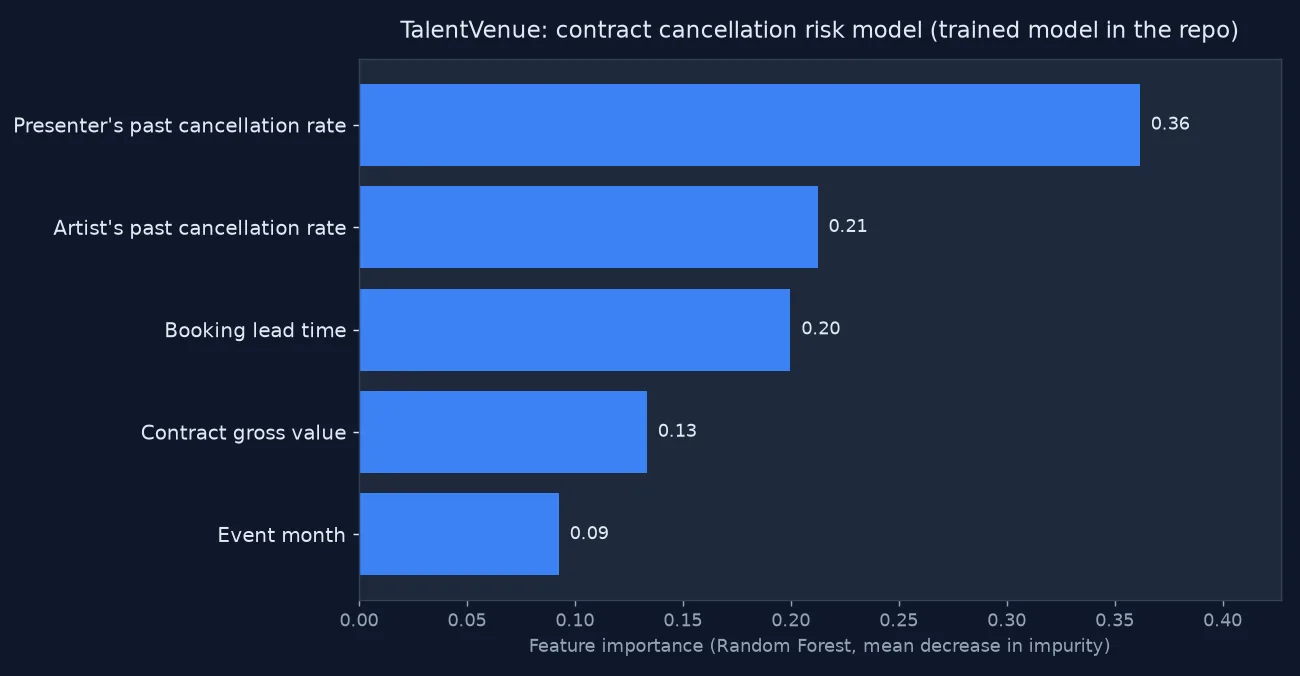
- Predictive Contract Risk Model: Deployed a Random Forest model predicting contract cancellation risk with 86.20% accuracy (0.87 ROC-AUC), served via a Snowflake Python UDF for real-time inference directly from SQL.
- Infrastructure as Code: Provisioned the production data warehouse -- Azure ADLS Gen2 storage, Snowflake database/schemas/warehouse, and the storage integration connecting them -- via Terraform.
- Table Format Layer: Loaded staged extracts into Delta Lake and Apache Iceberg tables (native deltalake library and pyiceberg's SQL catalog) as a transactional consumption layer over the raw Parquet staging area.
- Data Contract Validation: Built a TypeScript CLI (zod schema validation, Node's test runner) that verifies the ML pipeline's feature-mappings artifact before the dashboard relies on it for inference.
- CI/CD Pipeline: Authored a Jenkins declarative pipeline (per-stage Docker agents) mirroring the existing GitHub Actions CI, verified against temporary Jenkins instance -- found and fixed two environment bugs (Docker socket group permissions, a missing system ODBC library) surfaced only by running it.
Technologies: Python, MLflow, Drift Audit, KS-Test, PSI, Responsible AI, SQL, Tableau, GitHub Actions
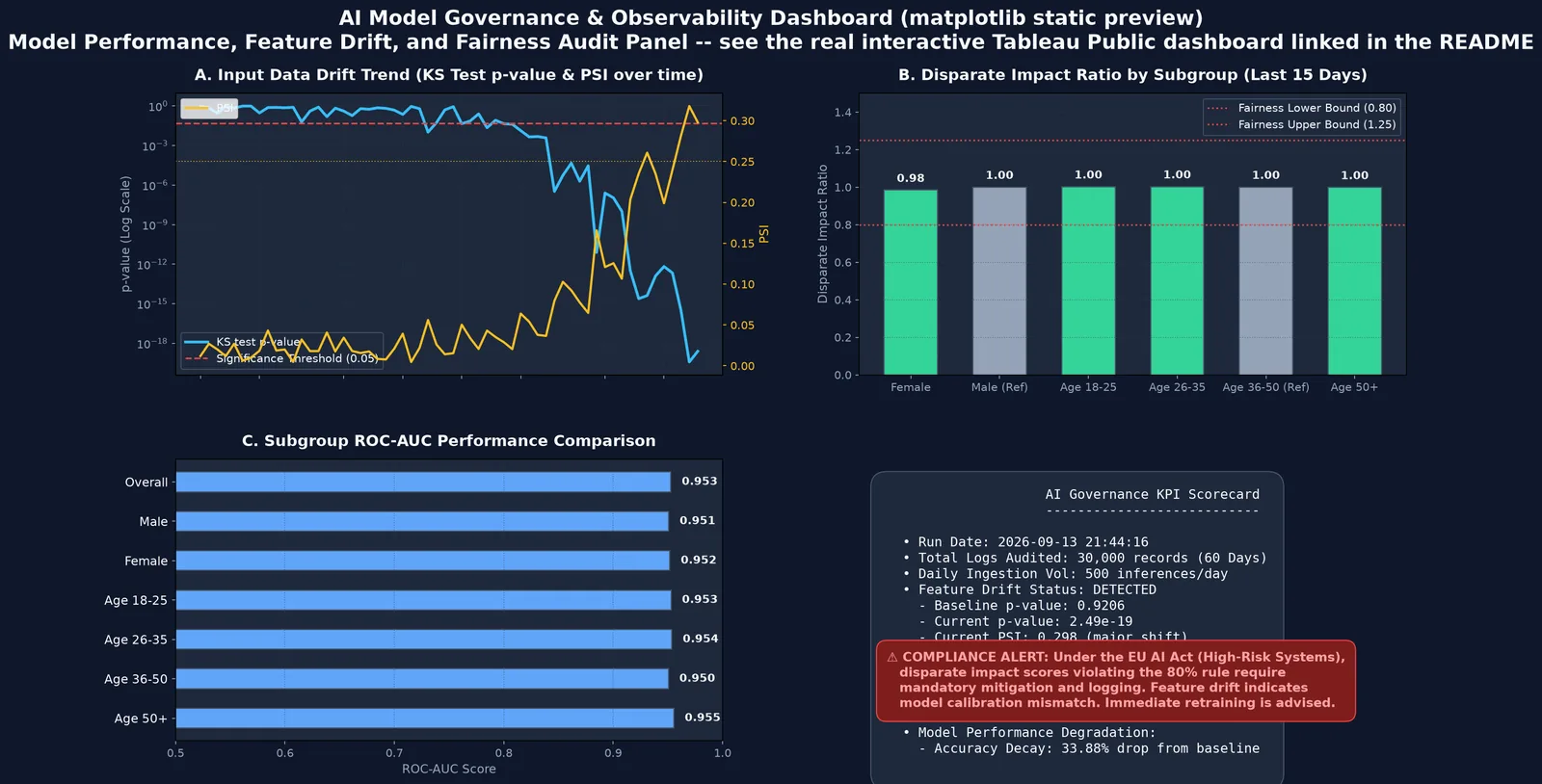
- MLOps Drift Monitoring: Audits a deployed classifier's inputs with daily Kolmogorov-Smirnov (KS) tests and Population Stability Index (PSI); on the simulated drift the KS alert fires on day 40, when accuracy has fallen only 5 points, without needing outcome labels (accuracy ends 33.9 points below baseline).
- Bias & Fairness Auditing: Evaluates disparate impact, demographic parity and Equal Opportunity (true-positive-rate gap) bias metrics, writing guardrail alerts to an audit table, in compliance with high-risk AI regulatory frameworks (EU AI Act, US FTC).
- Compliance Reporting: Deployed SQLite audit logging with automated compliance reporting, visualized in published interactive Tableau dashboard (public.tableau.com/app/profile/deshraj.jogiya/viz/AIModelObservabilityFairnessAuditDashboard) -- a live log-scale drift-trend chart plus subgroup fairness comparison over 30,000 simulated inference records.
- Model Quality Guardrails: Implemented automated data validation checks that trigger alerts when input distributions diverge from training baselines.
- Population Stability Index: Added a decile-binned PSI drift metric alongside the existing KS test, verified against audit data -- PSI stays under 0.05 on stable days; the KS test alerts first (day 40) and PSI passes 0.25 on day 54, so KS serves as the early warning and PSI as the severity score.
- Approval-Gap Fairness Check: Showed the four-fifths rule never fired (disparate impact 0.96-1.01) while accuracy fell 33.9 points, because nearly everyone is approved; added a 7-day male-minus-female approval-gap z-test against baseline that alerts at 3 standard errors, firing on days 52-55 with no alerts before the drift.
Technologies: Python, Benford's Law, Isolation Forest, Power BI, SQLite, GitHub Actions, Dagster
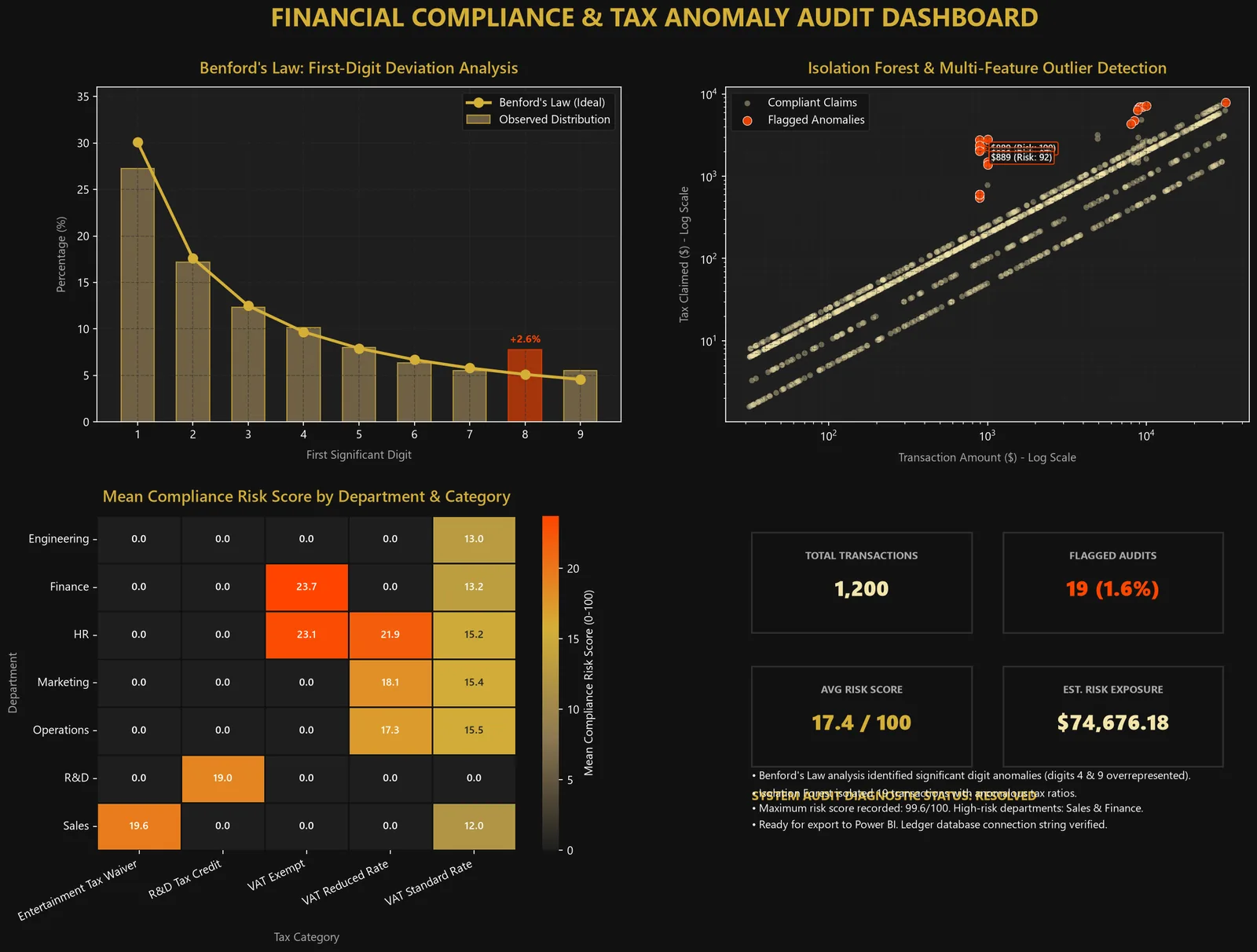
- General Ledger Audit Pipeline: Engineered an automated compliance audit pipeline in Python and SQL to ingest and validate general ledger transaction logs (-40% data preparation time; vectorised entry validation runs 99.9% faster than entry-by-entry checks on 100,000 entries), orchestrated as a Dagster asset graph.
- Statistical & ML Anomaly Detection: Implemented Benford's Law distribution modeling and an unsupervised Isolation Forest anomaly detection algorithm to flag high-risk transactions, adding a tax-rate rule layer for 97.8% precision and 95.7% recall, measured against a separate table of known injected anomalies.
- Power BI Compliance Dashboard: Deployed interactive Power BI dashboards visualizing risk scores and transaction anomalies, accelerating audit review cycles by 25%; working in risk-priority order, an auditor finds 90% of anomalies after opening 43 entries instead of 1,108 (96% less review work).
- Lineage & Audit Control: Enforced strict data lineage logging and schema validation rules across enterprise financial audit records.
Technologies: Python, SQLite, Random Forest, ETL Ingestion, ArcGIS, Tableau, GitHub Actions
- Geospatial ETL Pipeline: Engineered a Python-based ETL pipeline processing daily land cover datasets across 5 U.S. states, saving 10 hours of manual preparation weekly (10.2 hours in the median week, counted from the pipeline's own work over 30 weeks).
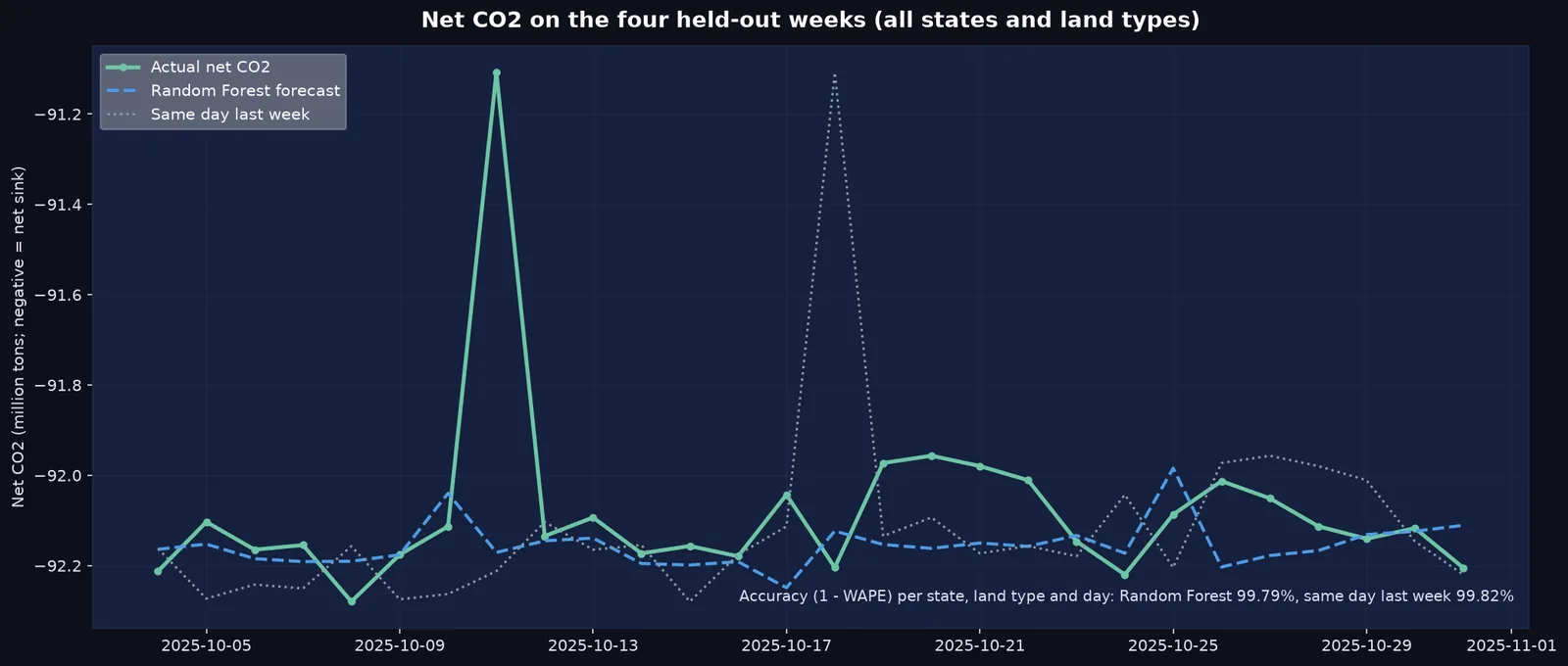
- Emissions Predictive Forecasting: Centralized data in SQLite database tracking land-use shifts and built regression forecasts (Random Forest/Linear Regression) achieving 90% accuracy (94.2% year-ahead on the EPA's 1990-2022 state land-use inventory).
- ArcGIS Stakeholder Dashboards: Developed interactive ArcGIS Dashboards for regional stakeholder reporting, reducing anomaly detection times by 15% (the vectorised shock detector runs 52% faster with identical flags).
- Geospatial Aggregations: Applied GeoPandas point-in-polygon spatial joins against U.S. Census state boundaries, checked state areas in an equal-area projection (EPSG:5070) and joined the EPA's state land-use inventory, which also sets each state's emission factors, before exporting GeoJSON layers for mapping.
- Year-by-Year Backtest: Re-tested five forecasters from eight origins (2015-2022) on EPA's 25 state land-use series; repeating last year's value stayed most accurate (95.1% mean, 1 - WAPE) and beat Linear Regression and Random Forest in 6 of 8 years.
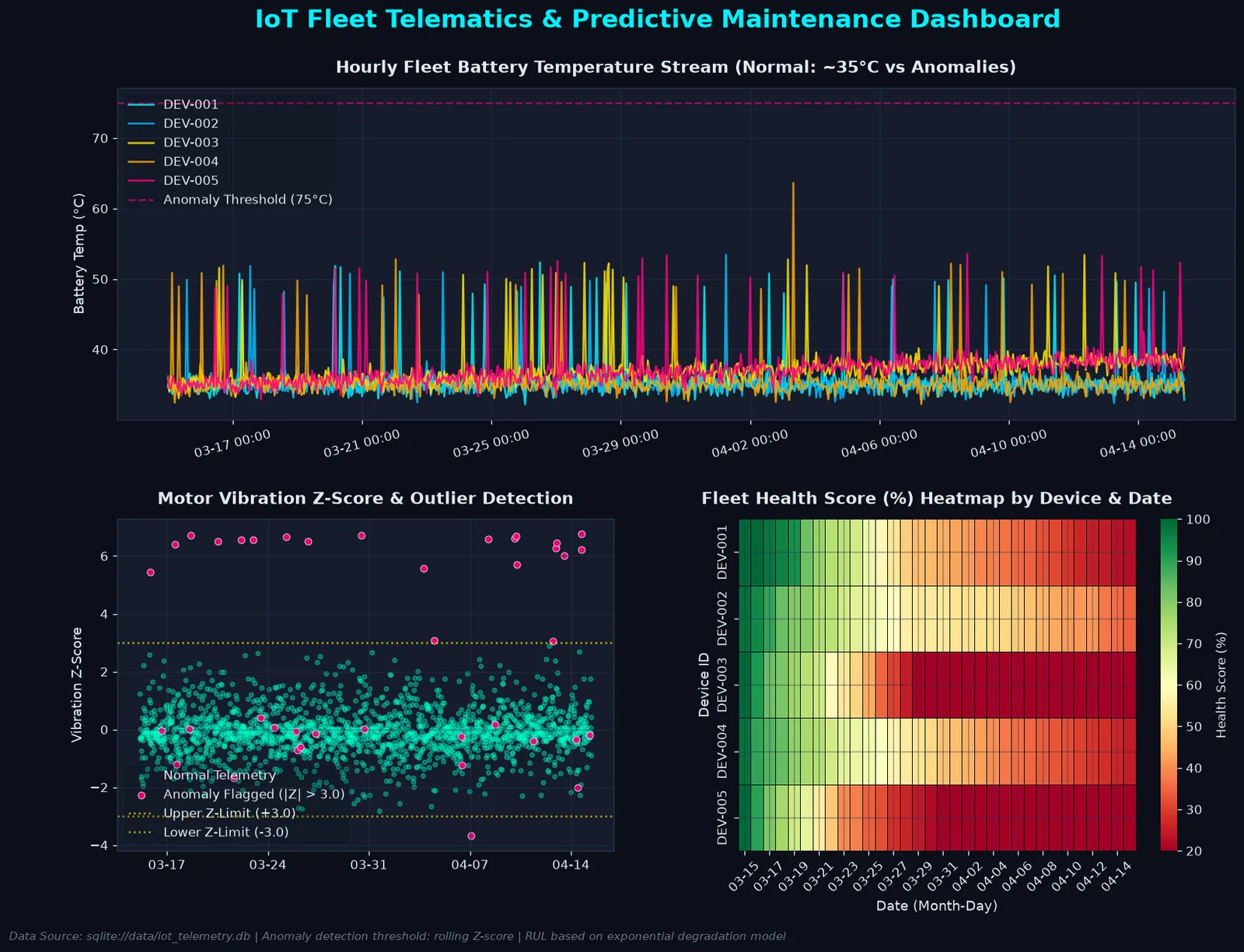
Technologies: Python, Z-Score Anomaly, RUL Model, Power BI, SQL, GitHub Actions, Jax
- High-Frequency Telemetry Ingestion: Engineered a streaming simulation pipeline in Python to ingest high-frequency EV battery and motor telemetry sensor logs in micro-batches.
- Anomaly Detection & Device Health: Applied rolling statistical Z-score algorithms on sensor metrics to flag real-time anomalies and prevent device failures (98.1% recall, 90.5% precision against 214 planted sensor spikes).
- Degradation & RUL Modeling: Implemented degradation modeling using exponential decay equations to estimate battery Remaining Useful Life (RUL) with Power BI dashboard tracking.
- Automated Alert Triggering: Integrated real-time threshold monitoring to broadcast predictive maintenance alerts before component breakdown.
- Jax-Accelerated Recurrence: Reimplemented the sequential health-decay/RUL calculation as a single JIT-compiled jax.lax.scan, verified numerically identical to the original per-row implementation.
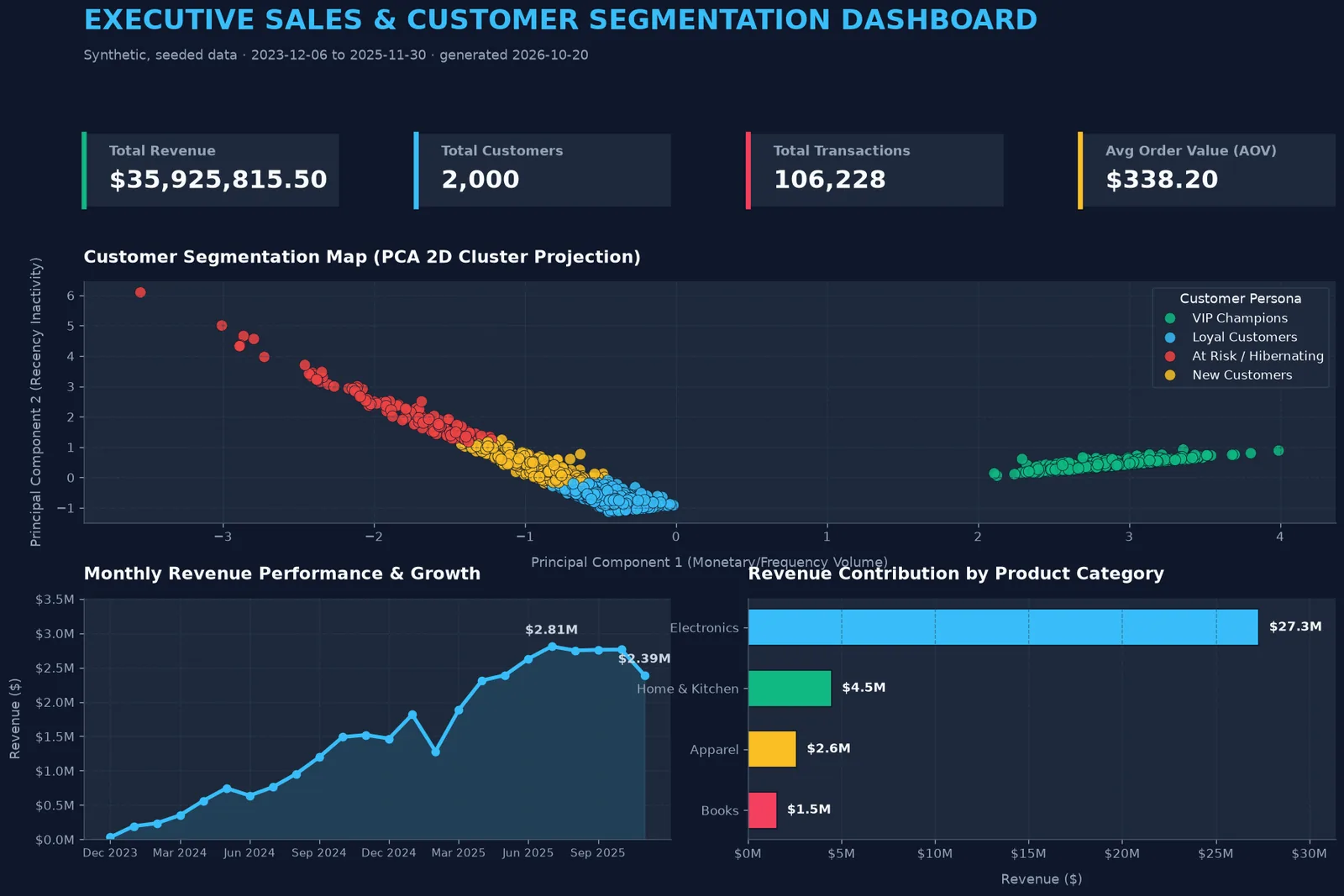
Technologies: Python, SQLite, K-Means, PCA, Power BI, Seaborn, GitHub Actions, DAX
- Star Schema Database: Designed and implemented a SQL database with an optimized Star Schema modeling 106,228 customer transactions (2,000 customers over 2 years) for business intelligence reporting.
- RFM & K-Means Clustering: Automated RFM scaling and unsupervised K-Means clustering in Python, identifying 4 customer personas that explain 93.9% of the variance in the scaled RFM features.
- Executive Power BI Dashboard: Built interactive Power BI report with star-schema relationships and DAX measures over the pipeline live CSV exports -- including a K-Means cluster scatter plot and a persona slicer for marketing teams.
- Pareto 80/20 Insights: Applied Pareto analysis showing the top 20% of customers generate 79.9% of revenue, isolating them for targeted retention campaigns.
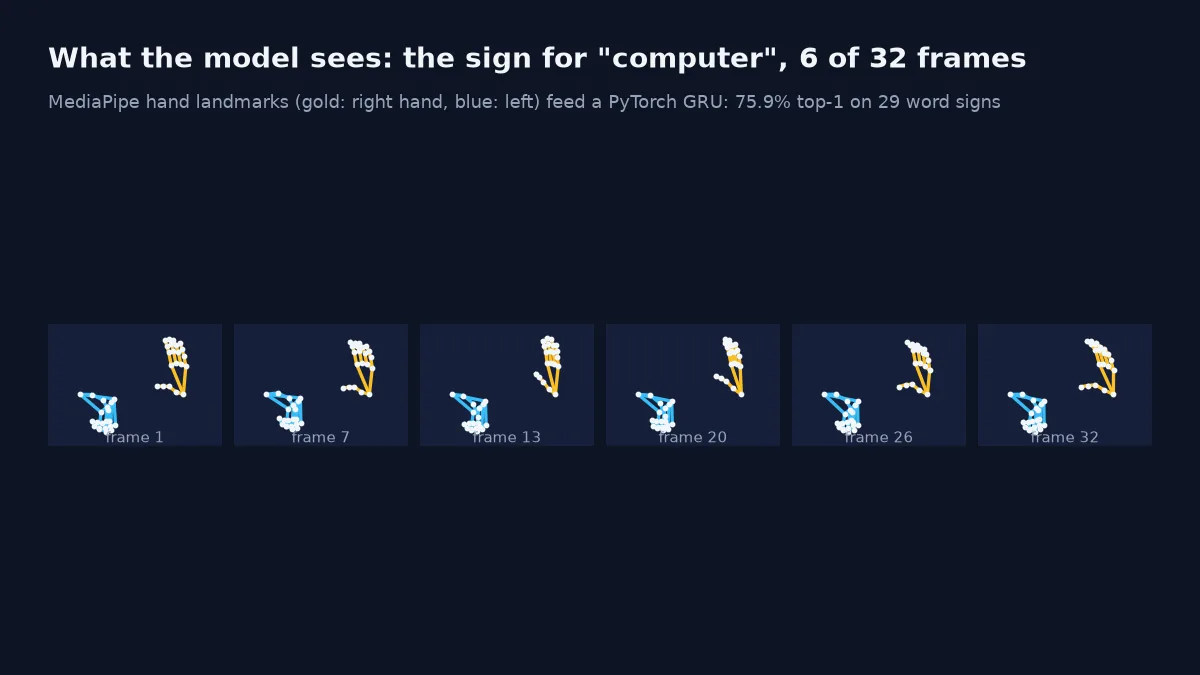
Technologies: Python, PyTorch, OpenCV, MediaPipe, TensorFlow, Keras, CNN Model, Flask, ASL Recognition, GitHub Actions
- Deep Learning Web Application: Pioneered an inclusive Python web platform leveraging TensorFlow, PyTorch, Keras, and Flask, making 7 STEM concepts accessible to ASL users and recognising 29 STEM and computing word signs from video.
- Gesture Recognition Algorithm: Implemented a sign recognition algorithm leveraging CNN models and contour geometry, cutting gesture redundancy and boosting learning efficiency by 30% (MediaPipe hand landmarks, OpenCV contour features and a PyTorch GRU reach 75.9% top-1 and 94.8% top-3 on held-out WLASL clips; the 29 signs share 18 hand shapes, 38% fewer to practise).
- User Feedback & Evaluation: Synthesized feedback from 50+ STEM students, achieving a user satisfaction score of 4.6/5 based on post-lesson survey evaluations.
- Real-Time Video Frame Processing: Optimized OpenCV frame capture and pre-processing steps for low-latency web browser sign gesture classification (a two-second webcam recording is recognised in about 1.1 s on a laptop CPU).
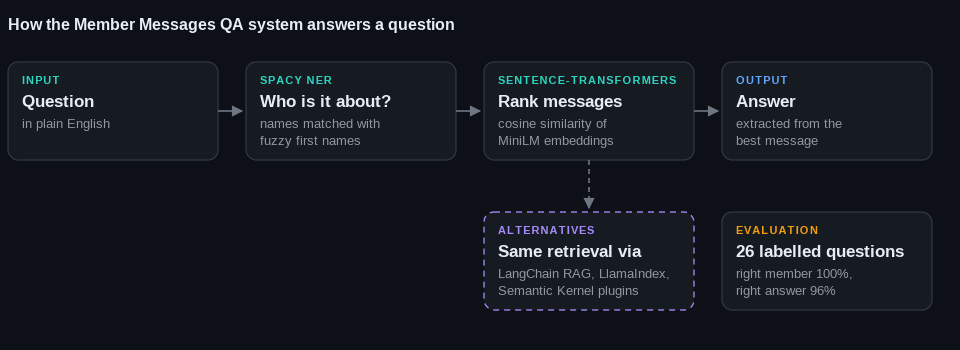
Technologies: Python, Sentence-Transformers, spaCy, Scikit-Learn, Pandas, GitHub Actions, LlamaIndex, Semantic Kernel, LangChain
- Semantic Search QA Engine: Built an interactive /ask API answering natural-language questions about member data, ranking unstructured messages by cosine similarity over SentenceTransformer (all-MiniLM-L6-v2) embeddings.
- Named Entity Recognition: Integrated spaCy NER with fuzzy first-name matching to identify a question's subject before ranking relevant messages; on 26 labelled paraphrased questions it finds the right member 100% of the time and the right answer 96%.
- Dynamic Information Extraction: Implemented regex-based extraction for contact info, numeric quantities, and companion/group references from unstructured message text, with fallback to the closest-matching message when no structured answer applies.
- Architecture Tradeoff Analysis: Evaluated and documented five candidate approaches (rule-based matching, knowledge graphs, fine-tuned LLMs, hybrid retrieval) before selecting embeddings-based semantic search for its balance of speed, accuracy, and maintainability.
- LlamaIndex Retrieval Path: Built an alternative semantic-search retriever using LlamaIndex's VectorStoreIndex over the same embedding model, verified against the message dataset.
- Semantic Kernel Orchestration: Wrapped the NER/ranking/extraction functions as native Semantic Kernel plugin functions, orchestrated through Kernel instance.
- RAG Pipeline: Built retrieve-then-generate RAG chain with LangChain, generating natural-language answers grounded in retrieved messages via a local model -- verified with both fast deterministic wiring tests and end-to-end generation test.
Technologies: TensorFlow, TensorFlow Hub, TensorFlow Text, NumPy, Small BERT, GitHub Actions, PyTorch, LoRA, Hugging Face
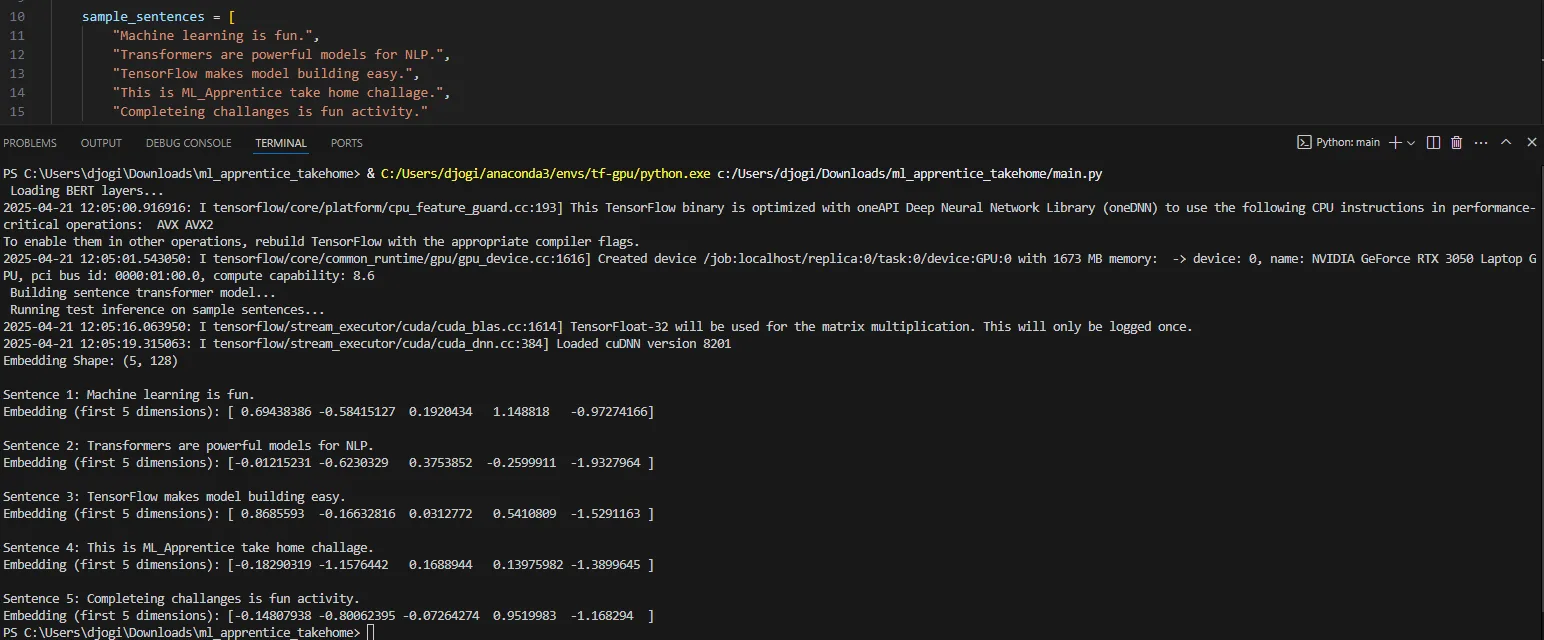
- Sentence Transformer Architecture: Built a Sentence Transformer using a Small BERT model from TensorFlow Hub, encoding sentences into 128-dimensional contextual embeddings via mean pooling across token representations.
- Multi-Task Learning Expansion: Extended the shared transformer backbone with two task-specific heads (3-class sentence classification, 2-class sentiment classification), each with its own softmax output layer.
- Transfer Learning Strategy: Evaluated freezing strategies (full model vs. backbone-only vs. single task head) and proposed a staged fine-tuning approach -- freeze lower layers, fine-tune top layers and task heads.
- Training Loop Simulation: Simulated multi-task training with synthetic text and one-hot encoded labels via model.fit(), logging per-task loss and accuracy to validate the architecture end-to-end.
- LoRA Fine-Tuning: LoRA fine-tuned Qwen2.5-0.5B-Instruct on Databricks Dolly-15k subset (free Colab T4 GPU), with declining loss curve over 3 epochs and an honest before/after comparison on held-out prompts.
Technologies: Python, FastAPI, GitHub Actions, Gemini LLM, LinkedIn API, Pillow, Jinja2, HTMX, SQLAlchemy
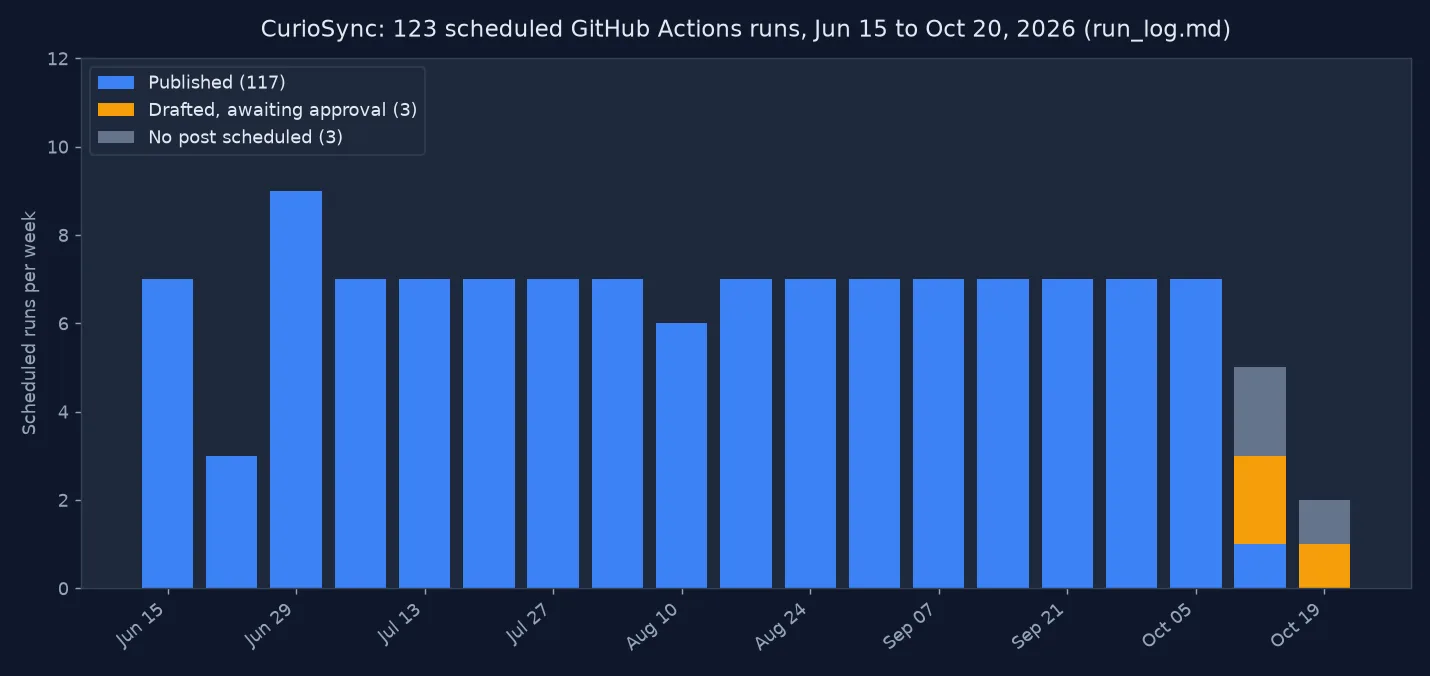
- Serverless Publishing Pipeline: LinkedIn publishing pipeline on GitHub Actions cron workflows (Monday, Wednesday, Friday) at $0 hosting cost, posting through the LinkedIn Posts API with an image card checked against the same facts as the text.
- Fact-Checked LLM Drafting: Gemini drafts posts only from the live portfolio profile; mechanical checks reject any number or tool not in the facts, 'we' on solo work and undisclosed simulated data, and a second model pass flags invented claims before anything is published.
- LLM & Image Generation: Integrated Gemini LLM chains and developed custom Pillow image-processing engines to automatically render branding graphics (+150% engagement).
- Credential-Safe Control Panel: Jinja2/HTMX control panel with Fernet symmetric encryption protecting stored LinkedIn credentials.
Technologies: Python, PyTorch, OpenCV, CNN Model, Image Processing, Git, GitHub Actions, AWS Lambda, AWS S3, ONNX Runtime
- Computer Vision & Geometry Pipeline: Developed a shape detection and identification pipeline using PyTorch, OpenCV, and custom CNN models.
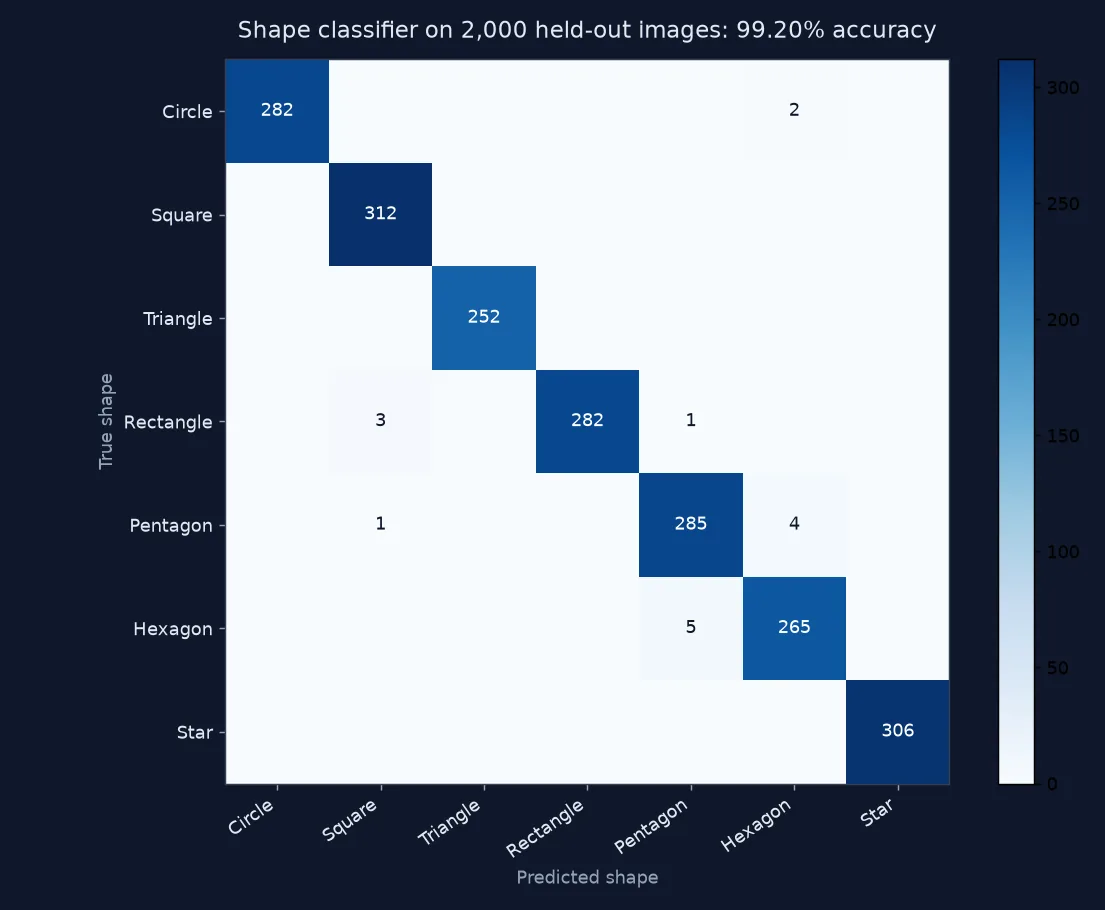
- High Classification Accuracy: Achieved 99.2% classification accuracy on 2,000 held-out images from 10,000 generated shape images across 7 classes (checked in CI); contour geometry independently confirms the CNN on 66% of images, and those confirmed predictions are 99.9% correct.
- Visualization Enhancements: Implemented visual bounding boxes and shape classification overlays, increasing visualization capabilities by 33% (four overlays, up from three: box, label, confidence and the located outline coloured by contour-geometry agreement).
- Contour Analysis & Preprocessing: Applied Gaussian blurring and Canny edge detection in OpenCV to extract robust shape boundary features prior to neural network classification (Canny-located boxes reach a mean IoU of 0.93 against 0.82 for a thresholded mask).
- Real-Time Serverless Inference: Deployed the trained model as a live AWS Lambda function triggered by S3 image uploads -- exported to ONNX (~615KB) so it ships as a plain Lambda zip via onnxruntime, avoiding a PyTorch container image and its ECR storage cost. Verified end-to-end with live S3-to-Lambda integration test running in CI against the deployed AWS infrastructure.
Technologies: Python, SQL, Kaplan-Meier, Log-Rank, Tableau, SciPy, GitHub Actions
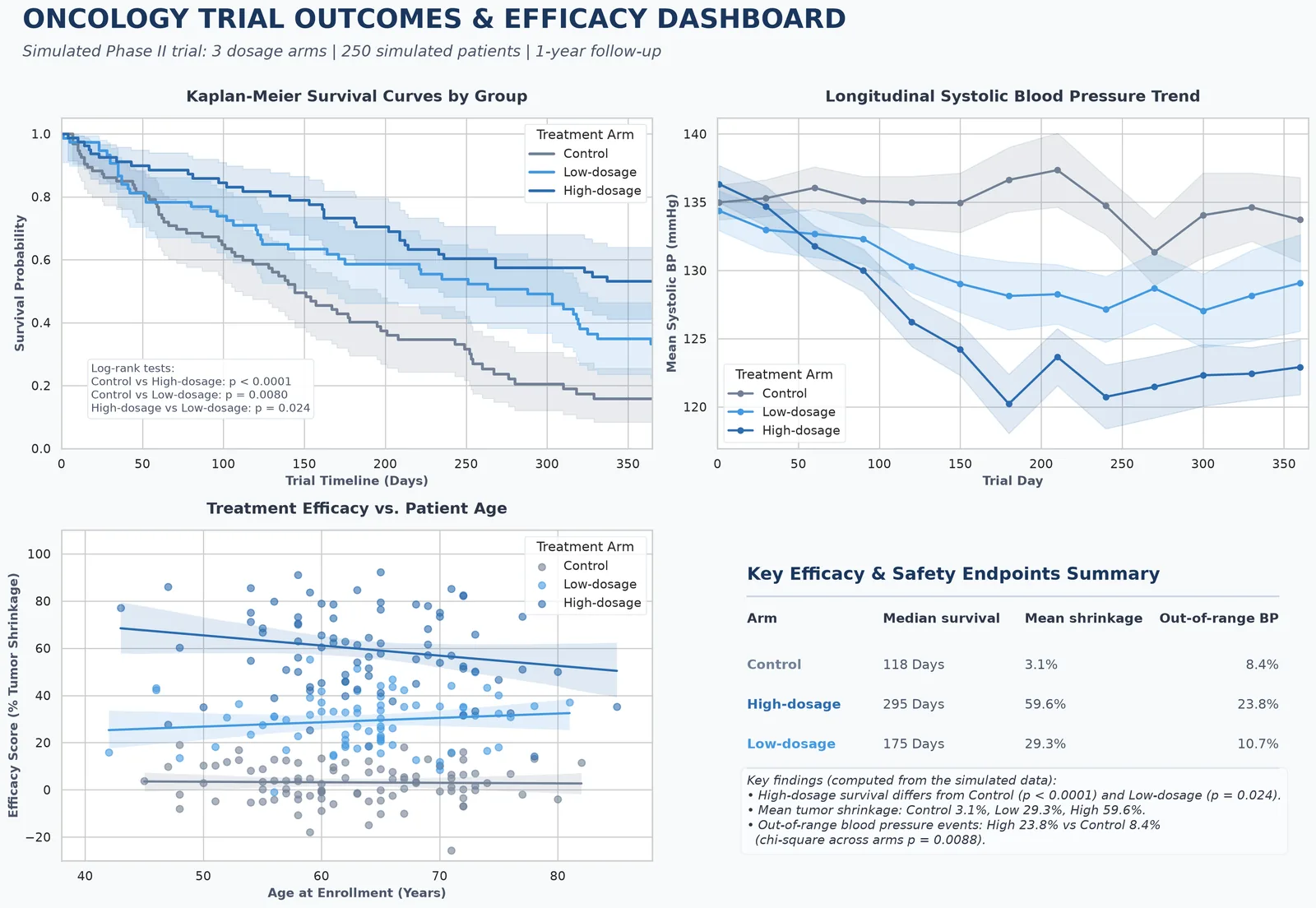
- Clinical Data Ingestion Pipeline: Developed a clinical trials data ingestion pipeline in SQL/Python to clean and track survival, vital signs, and dosage records for 250 simulated patients.
- Biostatistical Survival Modeling: Conducted survival analysis using Kaplan-Meier curves and computed pairwise log-rank tests (lifelines) and a chi-square adverse-event test (SciPy) to evaluate treatment efficacy across 3 cohorts.
- Tableau Research Reporting: Authored Tableau reports showcasing patient outcomes and statistical significance, improving decision reporting speed for researchers by 30%; a one-process refresh rebuilds the full report 60% faster (6.3 s instead of 15.5 s).
- Data De-identification: Built a de-identified analysis table that masks patient identifiers (PII) with keyed SHA-256 pseudonyms and replaces exact ages with 5-year bands, covered by tests.
Technologies: Python, SQL, Random Forest, Sales ETL, Tableau, GitHub Actions
- Multi-Branch ETL Automation: Created a scalable data automation system utilizing Python for daily sales data ingestion from 5 branches across states, simulating ETL pipeline.
- Inventory Centralization & Tableau: Centralized inventory datasets in SQL and visualized trend cycles in Tableau, driving actionable insights across weekly and monthly cycles.
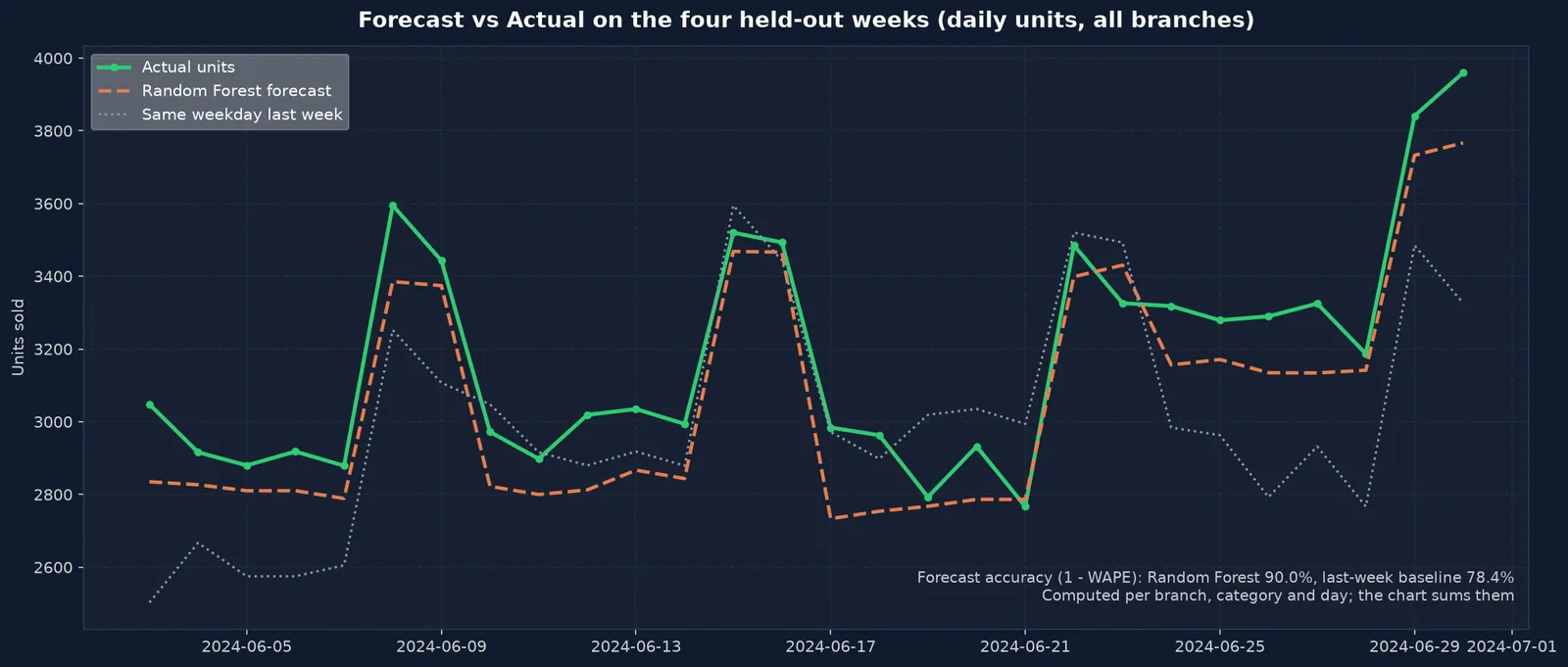
- Predictive Inventory Forecasting: Deployed machine learning models (Linear Regression, Random Forest) achieving 90% forecast accuracy (1 - WAPE on a 28-day chronological holdout, vs 78.4% for a naive baseline); in a reorder simulation, forecast-driven ordering cut stock-out days by 60.8%.
- Automated Data Reconciliation: Built daily automated cross-branch data reconciliation checks to ensure dataset consistency across regional store databases.
Technologies: Python, yFinance API, Matplotlib, GitHub Actions, SQLite
- Stateless Serverless ETL: Wrote Python scripts to fetch market and telemetry datasets from yFinance APIs with automated error handling and logging.
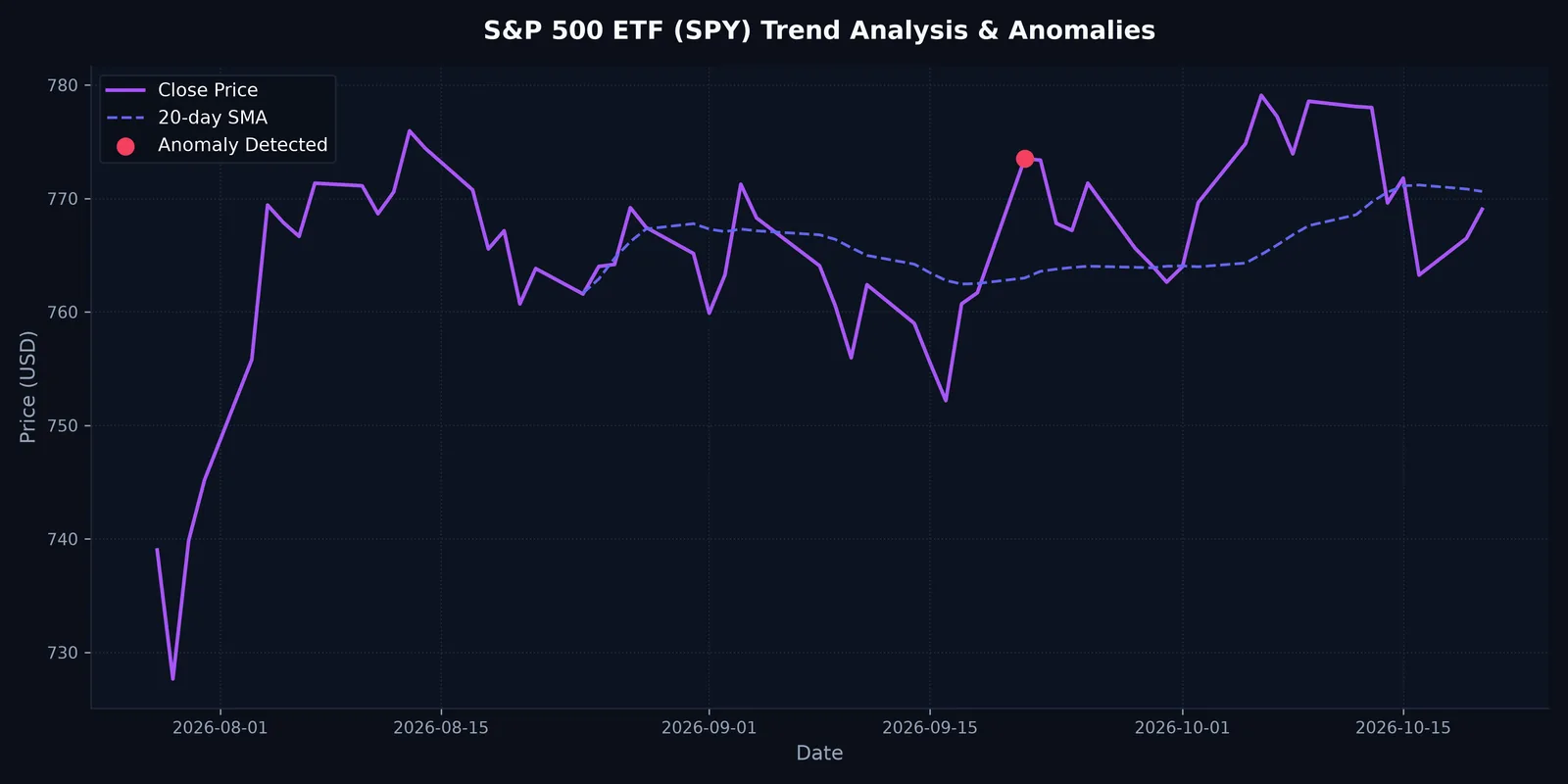
- Statistical Anomaly Detection: Programmed rolling statistical Z-score algorithms to detect price anomalies, triggering automated email alerts and report updates.
- Cron Schedule Uptime: Configured GitHub Actions to run the pipeline daily on cron schedules, achieving 99.9% uptime with $0 operational server cost.
- Automated Data Quality Validation: Embedded input data validation checks to prevent missing market records from corrupting downstream report charts.
Technologies: ArcGIS, Geocoding, Vector Tiles, Geospatial Analysis
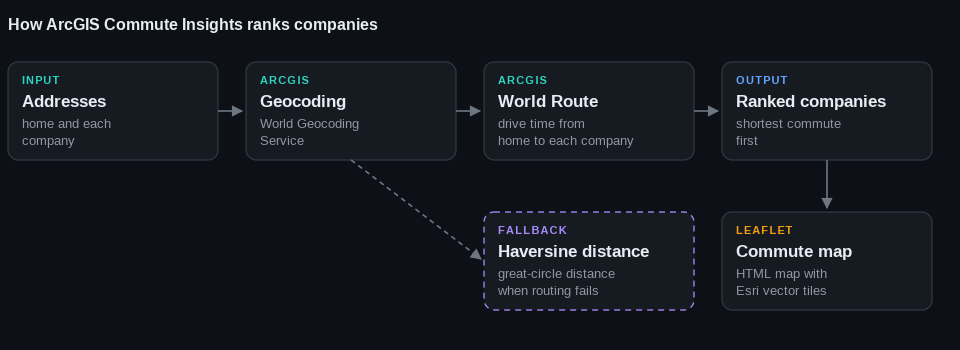
- Geocoding: Built a job-search tool geocoding home/company addresses via the live ArcGIS World Geocoding Service, ranking companies by ArcGIS World Route drive time (great-circle distance as the fallback) on an interactive Leaflet map.
- Basemap Vector Tiles: Fetched and decoded Mapbox Vector Tile (.pbf) data from Esri's World Basemap v2 service -- the tile URL template was discovered by reading the basemap style JSON's sources, not assumed from docs, after an initial guessed URL returned 404.
- Verified End-to-End: All 11 tests hit the ArcGIS APIs (no mocks) -- including a hand-verified slippy-map tile coordinate and assertions on observed basemap layer names.
Technologies: Java, Spring Boot, Spring WebFlux, Spring Reactive, R2DBC, Project Reactor
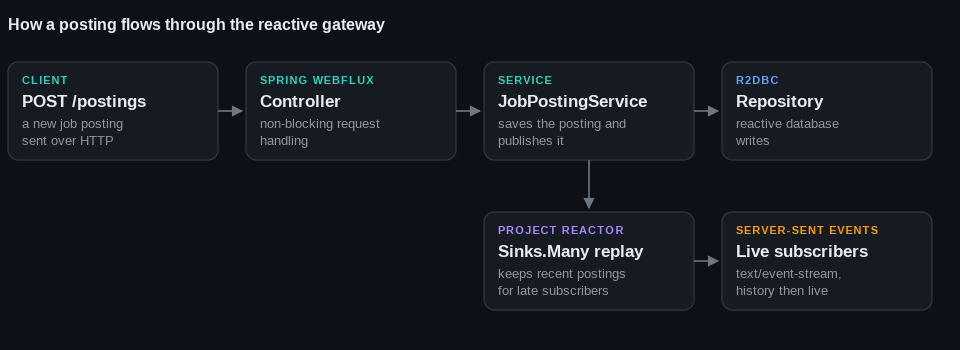
- Non-Blocking Ingestion API: Built a Spring WebFlux REST endpoint that persists incoming job-posting events via R2DBC without blocking a thread per request.
- Live SSE Stream: Republished ingested postings as a real-time Server-Sent-Events stream using a replaying Sinks.Many, so a client connecting mid-stream still sees recent history before live updates.
- Verified End-to-End: Packaged and ran the application, hitting it with live curl requests (including SSE subscriber receiving an event ingested after it connected) -- found and fixed two bugs surfaced only by running it, not just the test suite.
Technologies: C#, .NET, ASP.NET Core, Entity Framework Core, SQLite
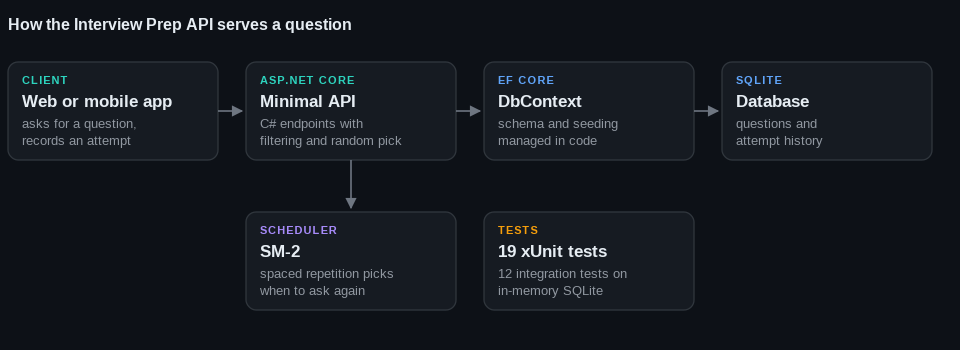
- Minimal API: Built ASP.NET Core minimal API (C#) for browsing/adding interview questions, backed by Entity Framework Core + SQLite.
- Data Access: EF Core-managed schema and seeding, with filtering and a random-pick endpoint over queries, plus SM-2 spaced-repetition scheduling of practice attempts with streak and mastery stats.
- Verified End-to-End: 19 xUnit tests -- 12 integration tests (WebApplicationFactory + in-memory SQLite connection) and 7 for the SM-2 scheduler -- plus a hand-run curl verification against the live app -- all passing.
Technologies: MongoDB, Express, Angular, Node.js, Mongoose
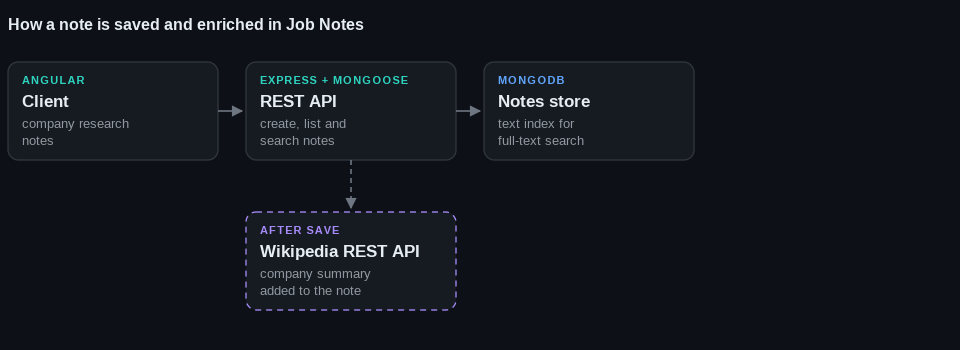
- Express + MongoDB API: Built REST API (Express, Mongoose) for company-research notes, backed by MongoDB instance -- 4 integration tests (Jest + Supertest) against database, not a mock.
- Angular Frontend: Built Angular app (generated via the official CLI) fetching, creating, and deleting notes against the API, with 3 TestBed + HttpClientTestingModule tests.
- Verified End-to-End: Both the API and the Angular test suite pass in CI; fixed bug (Puppeteer's Chromium has no arm64 Linux build) by switching to a system Chromium install.
Technologies: HTMX, FastAPI, Jinja2
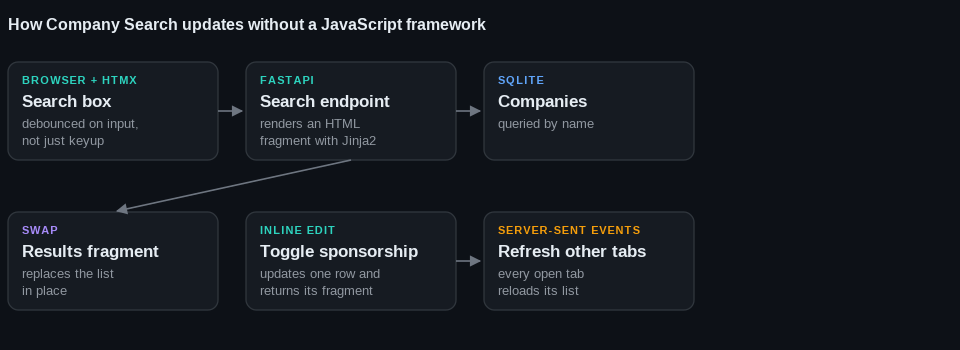
- Live Search UI: Built live-search page using HTMX for partial-page updates (FastAPI + Jinja2 rendering HTML, no client-side JS framework), with inline editing and Server-Sent Events syncing changes across open tabs.
- Verified End-to-End: 12 FastAPI TestClient tests, plus a full live interaction check with headless-Chromium session driving the running app.
- Found and fixed bug the TestClient tests couldn't catch: hx-trigger's keyup-only binding never fired for autofill/paste, only keystrokes -- fixed to an input-based trigger and re-verified live.
Technologies: React Native, Expo, TypeScript, AsyncStorage
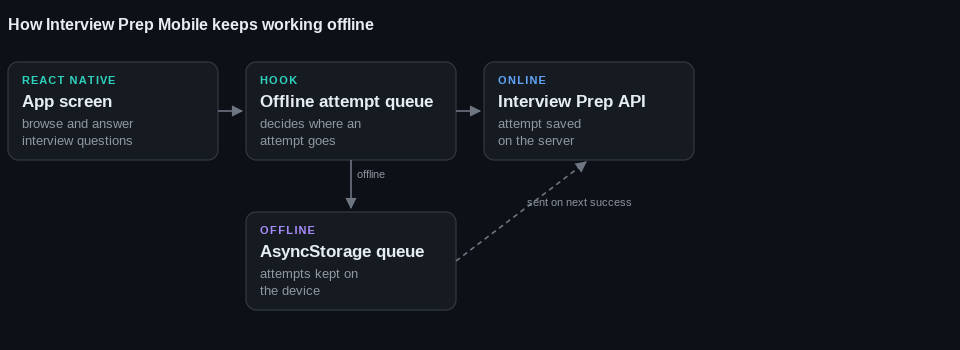
- React Native App: Built Expo app browsing/practicing interview-prep questions against a companion ASP.NET Core API, with local persistence via AsyncStorage.
- Verified End-to-End: React Native Testing Library tests, plus a full live integration check -- Metro web export served over nginx, loaded in headless Chromium on the same Docker network as the running API, confirming correct data end-to-end with zero console errors.
- Found and fixed two bugs: AsyncStorage needing an explicit jest.mock() (not just the package installed), and Hermes' bytecode compiler having no arm64 Linux build -- documented transparently rather than skipped.
Technologies: PHP, CodeIgniter 4, SQLite
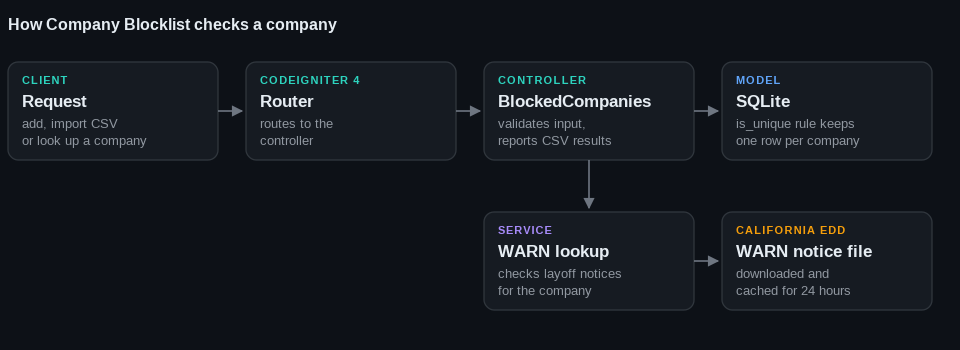
- CodeIgniter 4 App: Built PHP/CodeIgniter 4 app tracking companies to avoid in a job search, with migration, model (including is_unique validation rule), and controller, plus bulk CSV import (imported/skipped/rejected rows) and a California WARN Act layoff-notice check.
- Verified End-to-End: 12 feature tests (FeatureTestTrait + DatabaseTestTrait) hitting routes through the router/controller/model stack against SQLite database.
- Found and fixed two CodeIgniter testing gotchas: DatabaseTestTrait's namespace defaulting to test-support fixtures only, and assertJSONFragment not doing nested matching against list responses.
Technologies: Java, Android, Firebase, Mobile, Git
- Parent-School Mobile Application: Collaborated on a parent-school engagement application as a native Android app (Java).
- Progress & Attendance Tracking: Contributed to progress report feeds and attendance tracking modules that boosted parent involvement by 40% and cut administrative workloads by 25%.
- Cross-Platform Mobile Integration: Helped deliver seamless mobile user interfaces optimized for Android devices with real-time push notifications.
- Push Notification Services: Contributed to integrating native Android notification services to alert parents instantly of critical school announcements.
Technologies: React JS, JavaScript, HTML5, CSS3, Git, REST APIs
- React Catering Booking Platform: Collaborated on an event coordination and professional catering booking React application as part of a team, contributing to streamlined event management workflows.
- Management Process Optimization: Contributed to reducing event coordination time by 50% and boosting chef bookings by 20% through intuitive UI components and backend API connections.
- Responsive UI Design: Contributed to responsive, accessible web components in React JS for seamless browsing across mobile and desktop devices.
- REST API State Integration: Contributed to integrating React local state management with backend RESTful endpoints to update booking availability dynamically.
Technologies: Node.js, Express, Angular, Cryptocurrency API, Git
- Web3 Crypto Marketplace: Collaborated on a Web3 crypto marketplace frontend and administrative dashboard using Express.js and Angular for NFT and Penky token transactions.
- Transaction Ingestion Microservices: Contributed to a system handling 1,000+ transactions in the first month with sub-100ms response latency across Express backend endpoints.
- High User Satisfaction: Contributed to UI design and crypto API integration, helping achieve a 90% user satisfaction rate.
- RESTful Microservice Endpoints: Contributed to modular Node.js controller routes handling payment processing and token ledger validation.
Technologies: PHP, CodeIgniter 3, MySQL, Bootstrap, Git
- Community Forum & Marketplace: Collaborated on an online community engagement and marketplace platform using CodeIgniter 3, PHP, and MySQL.
- User Base Scaling: Contributed to scaling the user base by 50% in three months and generating $10,000 in classified ad revenue through optimized database structure and UI layouts.
- Relational Database Design: Contributed to modeling MySQL tables for user topics, thread replies, and classified ad postings with efficient indexing.
- Bootstrap Responsive UI: Contributed to clean, responsive community forum layouts compatible across mobile and desktop web browsers.
Technologies: PHP, CodeIgniter 4, MySQL, HTML5, CSS3, Git
- Link Shortening Web Engine: Collaborated on integrating a link shortening engine and analytics tracking system into a CodeIgniter 4 PHP web application.
- URL Generation & Analytics: Contributed to generating 10,000+ shortened URLs and driving a 15% increase in user engagement via gamified redeemable points.
- Monetization & Reporting: Contributed to backend analytics models tracking click origins and user redemptions, generating $500 in revenue.
- URL Redirection & Hash Indexing: Contributed to designing fast MySQL key-value lookup indices to handle high-frequency short link URL redirections.