Career Pilot: a job-search assistant in production
A self-hosted platform that collects job postings, scores how well each matches the candidate's master profile, drafts a tailored resume and cover letter, and pre-fills application forms. Every application is reviewed and submitted by a person.
- Result
- 7 applicant-tracking systems filled, nothing sent without a human click
- Built for
- One job seeker running a long search, and anyone who forks it to run their own copy.
- Role
- Sole developer: design, build, tests and deployment
- When
- Feb 2026 – Present
Public demo with a sample profile; automation is off and nothing is ever submitted.
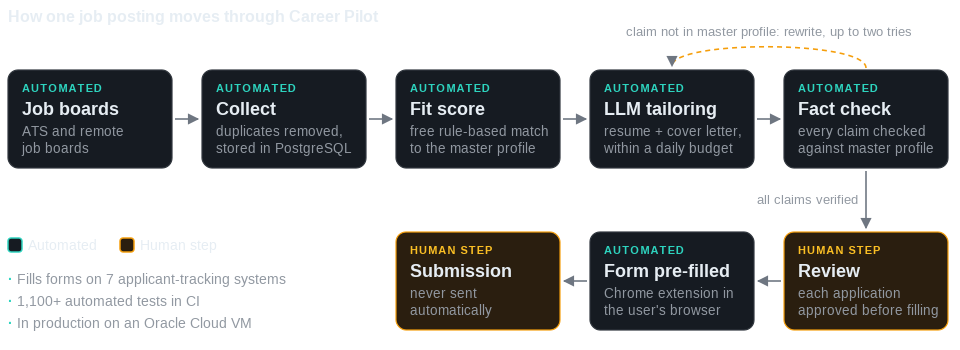
How it works
- Intake from direct ATS boards (Greenhouse, Lever, Ashby, Recruitee, Personio, Workable, SmartRecruiters) and remote job boards, with duplicate removal
- A free rule-based fit score first; only postings that can still reach the tailoring threshold go to the LLM
- LLM tailoring (Claude by default, Gemini and Ollama as alternates) under a daily spending limit
- A non-LLM fact check against the master profile; a failing draft gets up to two rewrites, then goes to human review
- A Chrome extension that pre-fills the application form in the job seeker's own browser
- FastAPI and Jinja2 on an Oracle Cloud VM behind Caddy HTTPS, PostgreSQL on Supabase with row-level security on every table
Data
Real job postings from public ATS and job-board APIs, and the owner's own profile. The public demo runs on a separate database with a sample profile and no API keys.
Problems found and decisions made
- The language model sometimes listed skills the candidate doesn't have
- Every generated resume is checked by ordinary code, not another model, against the master profile. Anything missing from the profile triggers a rewrite, then human review.
- An early version spent far more on API calls than planned
- Postings get a free rule-based score first, a posting that can't reach the tailoring threshold never reaches the model, and a daily spending limit is checked before every paid call.
- Employer sites blocked automated form filling from the cloud server
- Form filling moved into a Chrome extension in the user's own browser. Testing on seven applicant-tracking systems found fields inside Shadow DOM, upload fields hidden behind custom buttons and hidden decoy fields meant for bots, which are now left empty.
- The first location filter wrongly excluded 458 US postings
- It now excludes a posting only when its location names a country outside the US and Canada.
Testing and reliability
- 1,100+ pytest tests in GitHub Actions on every push
- Alembic migrations applied to PostgreSQL in production, with a test that the same chain runs on the demo's SQLite
- Encrypted daily backups, a health-check watchdog that restarts a hung service, and external uptime monitoring
- Row-level security on every table, with a regression test that fails if a new table ships without it
Results
- Running in production since February 2026 for a real job search
- Form filling verified live on 7 applicant-tracking systems
- Nothing is submitted or sent without a human click
Limits and next steps
- Workday forms need an account before any question is reachable, so they are only partly covered
- Custom phone-country pickers on some forms are left at the page's default